
Why I'm publishing my local AI numbers
This site is my lab notebook for local models and agents, measured on my own hardware, with the raw data attached to every post.
Fable 5.2 and Mythos 5.2 shipped cheaper and faster: $8/$40 per million tokens, output up to 30% faster. Prices, benchmarks, and what a run actually costs.
Anthropic released Claude Fable 5.2 and Claude Mythos 5.2 today. Both beat Opus 5.5 on almost every capability they evaluated. The benchmark wins are the headline. The price cut is the part that changes how you use them.
Fable 5.2 and Mythos 5.2 cost the same:
| Model | Input / 1M | Output / 1M |
|---|---|---|
| Fable 5.2 / Mythos 5.2 | $8 | $40 |
| Fast mode (same models, 2.5x faster) | $16 | $80 |
Both are cheaper than the 5.1 versions. The page does not list the old numbers, so I will not guess them.
What the new prices buy, in plain arithmetic. A run that reads 1M tokens and writes 200k costs $8 + $8 = $16. The same run at Fast mode prices costs $32.
On Anthropic’s own evals, Fable 5.2 beats Opus 5.5:
The number I care about is not in a table: at High effort, Fable 5.2 lands roughly on par with Opus 5.5 at Max effort on FrontierCode 2.0, at about half the cost per task. Max effort is the setting that spends the most tokens per answer. Getting the same result from a cheaper setting is where the savings live.
Output is up to 30% faster than Fable 5.1 and Mythos 5.1. Both models take a 1M token context and write up to 128k tokens per response.
Two demos from the announcement, because they show what the model is aimed at:
Both are prototypes, not products. The signal is the shape of the work: long, parallel, self-reviewing runs with many agents under one coordinator.
I run Opus 5.5 through Claude Code all day. My tracker shows the last 30 days at $1,199.57: 11.9M output tokens, 3.18B cache reads. Cache reads are the bulk of the volume, which is why the output price matters more than it looks: every token the model writes is the expensive part.
Anthropic still recommends Opus 5.5 as the daily driver and Fable for the large tasks. The company’s own guidance, and the one I agree with: most requests do not need the biggest model, and the effort settings matter more than the model choice. At High effort Fable 5.2 is about twice as fast as the default and still beats Opus 5.5 Max on the coding eval above.
Two patterns from the post are worth copying regardless of which model you pay for. The advisor pattern: Fable 5.2 plans, a smaller model executes. The orchestrator pattern: Fable 5.2 coordinates a team of subagents and decides when the work is done. Both buy speed or quality with architecture instead of with a bigger single bill.
Once I can run it through my own stack, I will publish the measured version of this post, same as I did with the DSpine numbers.
This site is my lab notebook for local models and agents, measured on my own hardware, with the raw data attached to every post.
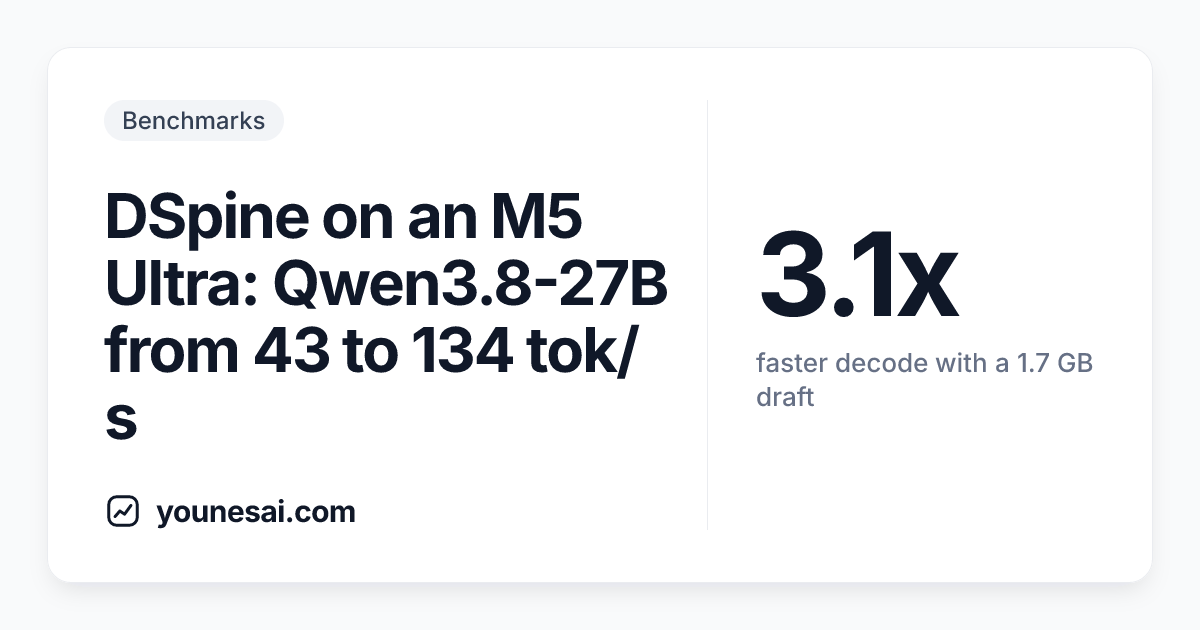
I benchmarked DSpine speculative decoding on a Mac Studio M5 Ultra. Qwen3.8-27B goes from 43 to 134 tok/s on code with a 1.7 GB draft. Full idle numbers.